
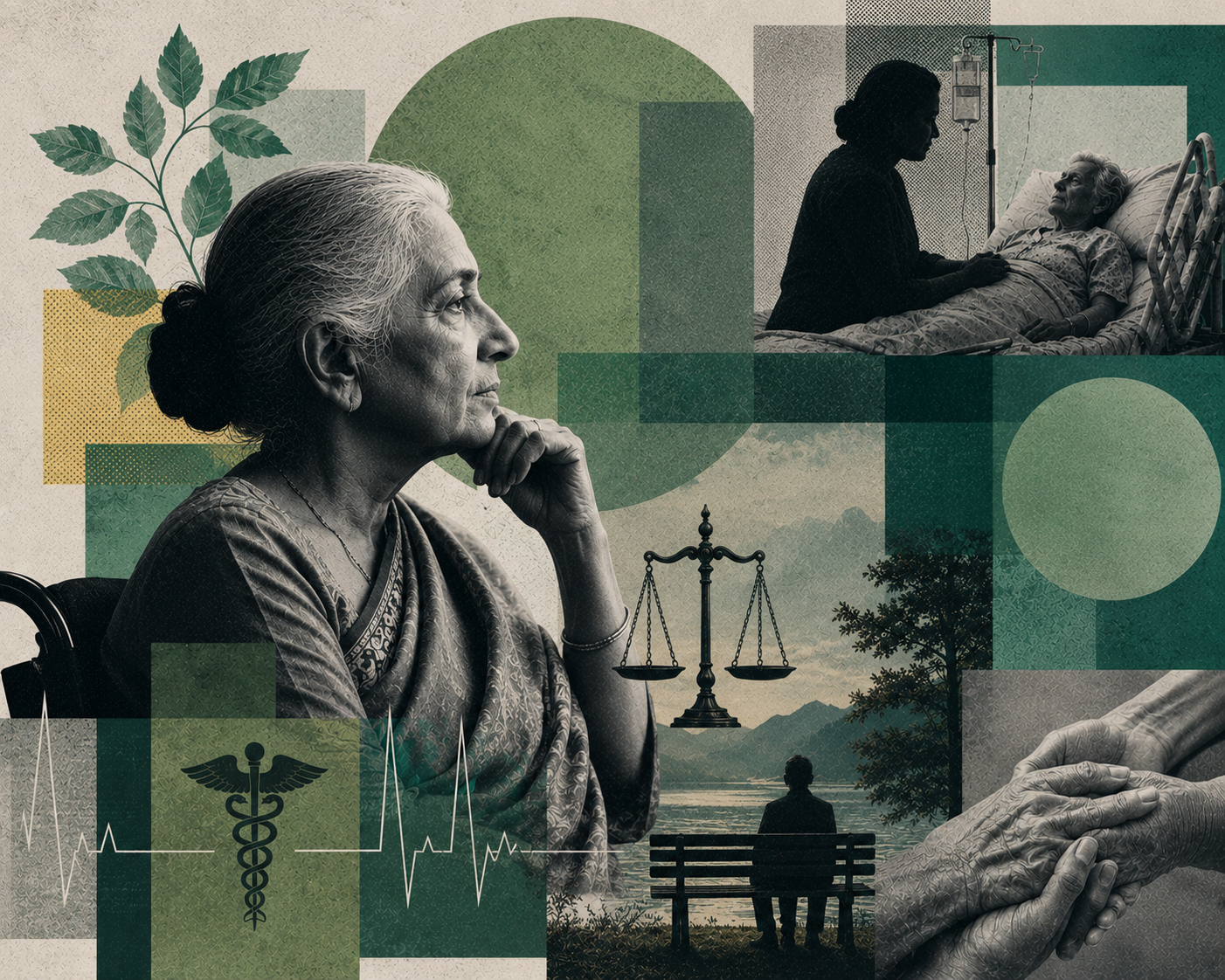


What is a Living Will?
A Living Will, formally known as Advanced Medical Directive (“AMD”), is a written document that deals with questions pertaining to medical treatment in advance, as the name suggests. This document records the preferences of an individual regarding end of life medical treatment while they are still healthy and have cognitive clarity. In short, an AMD or Living Will becomes an individual’s voice, when they no longer have one.
Indian Legal Framework
Today, apart from the Mental Health Act, 2017 which provides for medical directives by patients suffering from mental health issues, India does not have any dedicated legislation that deals with Living Wills for somatic (non‑mental health) conditions. In this scenario, the legal framework rests on judgements passed by the Supreme Court.
Milestone Judgements
Aruna Shanbaug v. UOI [(2011) 4 SCR 1057]: The case involved a nurse who had been in a persistent vegetative state (“PVS”) for 37 years following a brutal sexual assault by a hospital staffer. The Supreme Court dealt with the question of whether life support can be withdrawn from a patient who cannot give consent for the same. The Supreme Court proceeded to recognise the act of passive euthanasia (withdrawal of life‑sustaining treatment) and thus, paving the way for individuals to have dignity not just in life but in death as well. The Supreme Court laid down that in cases of terminally ill patients or PVS patients, the withdrawal of life support is permissible provided the same is done under the supervision of a High Court. This case distinguished passive euthanasia from active euthanasia, which remains illegal under the Penal Code.
Common Cause (A regd. Society) v. UOI (2018 INSC 223): Common Cause, a registered society, filed a writ petition before the Supreme Court seeking to declare that the right to die with dignity comes within the ambit of Art. 21, which deals with the right to life and personal liberty. A Constitution Bench of the Supreme Court observed that meaningful life includes a dignified death. The Supreme Court held that the right to live with dignity under Article 21 includes the right to “smoothen the process of dying” for terminally ill or PVS patients. Most significantly, the Supreme Court observed that advance medical directives / living wills are legally recognisable and enforceable, subject to safeguards framed by the Court under Article 142. The Supreme Court also laid down detailed procedures and guidelines for how Living Wills ought to be created and acted upon.
Modification of Common Cause Order [(2023) 1 SCR 1137]: Due to the procedural difficulties involving execution of Living Wills, such as attestation by a Judicial Magistrate at various stages and multi-tier board approvals, an application came to be filed by the Indian Society of Critical Care Medicine for modification of the Order passed by the Supreme Court in 2018 in the Common Cause case. While disposing this application, the Supreme Court noted that “insurmountable obstacles” existed in implementation of the 2018 directions and modified the guidelines to simplify the operational requirements for AMDs. The approval process was streamlined making the framework significantly more practical.
Procedure to Execute Living Wills by Somatic Patients
While there is no prescribed format or template, the Supreme Court has laid down guidelines that ought to be followed while executing a Living Will. The said guidelines operate as de facto standard rather than a formal statutory procedure.
Any adult (above the age of 18 years) who is of sound mind and is capable of understanding the purpose of the document, can voluntarily (without coercion or undue influence) execute a Living Will. The Living Will must clearly state the circumstances under which life-prolonging treatment can be refused or withdrawn. The Living Will must also specify the type of treatment that can be withheld. The Living Will must appoint a guardian who has the authority to give consent or refuse treatment on behalf of the patient. This Living Will can be revoked or amended at any time by the person making it, provided they have the mental capacity to do so.
A Living Will, like an ordinary Will, must be signed by the person making it on all pages. The document must be executed in the presence of two independent witnesses. The Living Will must be notarised by a notary public or gazetted officer, who must record that the document was executed voluntarily. A copy of the Living Will must be given to the family physician (if any) and to the custodian appointed by the jurisdictional corporation.
It is to be noted that a Living Will comes into operation only when the maker is terminally ill/undergoing prolonged treatment with no prospect of recovery/in a persistent vegetative state and no longer capable of making or communicating decisions. Until both conditions are met, the document has no legal effect on medical treatment being administered.
Challenging a Living Will
A Living Will is not absolute. The directives in a Living Will may be ignored if:
- There is doubt about whether the same was executed voluntarily, without coercion or undue influence.
- There is a change in circumstances which was not anticipated at the time of making the Living Will.
- There is ambiguity in the instructions/directives given in the Living Will as clarity is the touchstone of the document.
- Proper procedure was not followed while executing the document.
Implementing a Living Will for Somatic Patients
Implementing a Living Will involves actions of multiple authorities in India. Firstly, the treating physician is required to verify the authenticity of the Living Will when the patient’s condition triggers the directive. Thereafter, the hospital board consisting of senior specialists, where the patient is admitted, must review the case and form a preliminary opinion on whether the directive should be implemented. Once an opinion is formulated, a second board consisting of the Chief District Medical Officer and the District Collector must independently review the case and provide their decision within 48 hours. If the hospital board refuses to honour a Living Will, or if the two boards disagree, the guardian appointed, family, or treating doctor may approach the High Court for relief. The High Court may constitute its own expert board and decide the matter, guided by the patient's best interests.
A Call for Legislation
The Supreme Court, in the Common Cause case, acknowledged that euthanasia is a "highly debatable, controversial and complex" issue with strong views rooted in social morality, medical ethics and religious beliefs. But despite this view, the Supreme Court proceeded to recognise Living Wills.
Apart from judicial precedents, India does not have any legislation that regulates the formation and enforcement of Living Wills. The Law Commission of India had recommended legislation on medical treatment of terminally ill patients as early as 2012. However, the same remain unimplemented. A dedicated statute would bring several benefits such as legitimacy, legal certainty for doctors and patients, standardised registration systems, protection for healthcare professionals, mechanisms for implementation of Living Wills, amongst others.
Until a legislation is passed, India's framework for the right to die with dignity will remain what it has always been – a remarkable judicial achievement which most citizens are unaware of.